
I spoke with a business owner recently doing about $3 million a year.
Good business. Established reputation. Fifteen years in. Strong operator.
I asked him where his pipeline lived.
Part of it was in his head. Part of it was on a yellow legal pad. The rest was inside a spreadsheet his office manager updated “when she had time.”
That setup is more common than most people realize in businesses between $500K and $5 million.
And usually, it’s not because the owner refuses to use technology.
It’s because the business never built operational visibility around revenue.
A lot of companies at this stage are still running sales through memory, inboxes, conversations, notebooks, and disconnected spreadsheets.
That works while the owner is personally involved in every important relationship.
But eventually it creates a bottleneck.
Because once the pipeline only exists inside the owner’s head, the business becomes dependent on one person’s memory to function.
At that point, a few things start happening automatically.
First, nobody else can consistently help grow revenue.
Not because the team lacks ability.
Because they lack access to information.
The owner knows which deals are active.
Everyone else is operating from partial visibility.
Second, the business becomes harder to scale and less valuable.
Every serious buyer, lender, investor, or advisor eventually asks some version of the same question:
“Show me your pipeline.”
And if the answer requires reconstructing opportunities from memory or piecing together spreadsheets and notes, confidence drops quickly.
Because undocumented pipeline usually signals undocumented process.
Third, the company loses the ability to accurately measure sales performance.
Close rates. Pipeline velocity. Average deal size. Lead conversion. Sales cycle length. Follow-up consistency.
These are not vanity metrics for enterprise companies.
They are operational metrics for any business trying to grow predictably.
Without visibility into them, most revenue decisions become reactive instead of measurable.
And to be clear, this usually does not require expensive software.
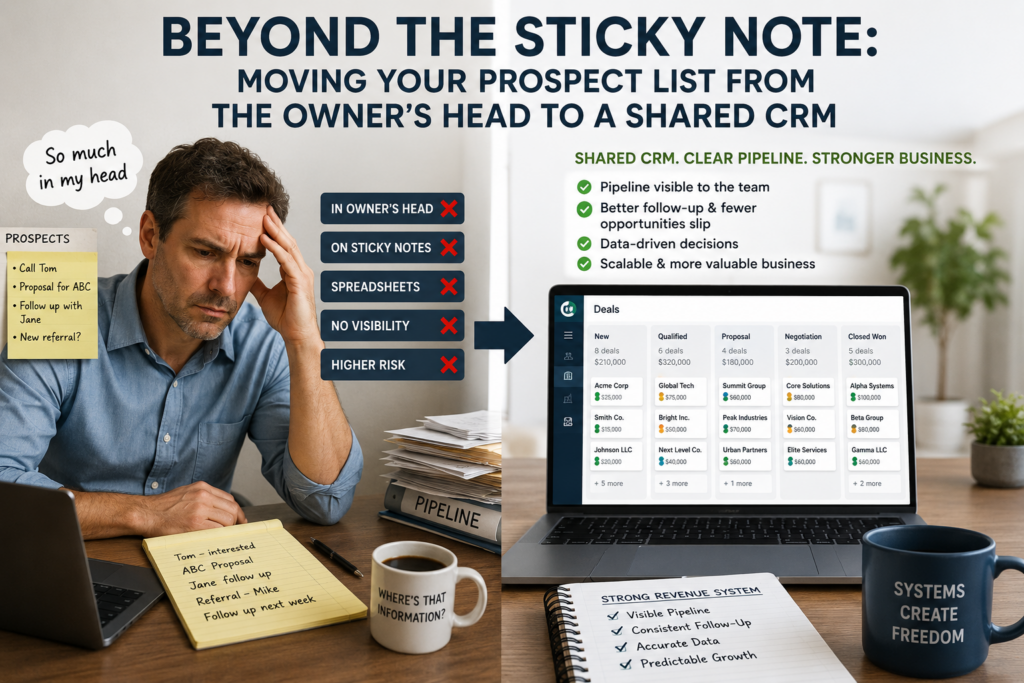
Most businesses at this level do not need a massive CRM implementation.
HubSpot. Pipedrive. A structured Airtable. Even a simple shared system is enough to create visibility.
The important thing is not the platform.
The important thing is that the pipeline exists outside the owner’s memory and is accessible to the business.
Because if sales activity disappears every time the owner gets busy, pulled into operations, or steps away for a week, the company does not really have a revenue system yet.
It has founder dependency.
We score this inside the BOI System under Grow Tools at Level 2 because it’s foundational.
And a surprising number of otherwise sophisticated businesses fail it.
Your pipeline is either documented or it isn’t.
If it only exists in someone’s head, it’s not a system.
It’s risk.
Schedule a call with us to learn how our OQ Diagnostic leads to a phased 12-month plan your people can implement without a high priced consultant. Click Here!
Review pricing on your own OQ Score diagnostic and a 12-month plan here by clicking here.
#BusinessOperations #RevenueLeadership #BOISystem #OwnerOperated #SmallBusinessGrowth