
The Person, the People, and the System Behind Marketing, Sales, and Offering Development and What Artificial Intelligence Does to the Answer
A research brief prepared for institute fellows and MBA faculty
Over50Pros · Strategic Operations Advisory Working paper · June 2026
Framing note. This is a research brief, not a sales document. It is written to be read, argued with, and cited. The instrument under discussion: The Growth Work – Team item of the OQ Score is used here as a structured object of study, because it isolates a question the management literature has examined for sixty years but rarely states this plainly. Who, exactly, is responsible for finding, winning, and keeping customers, and how is that responsibility structured? Where evidence is vendor-reported rather than peer-reviewed, it is flagged as such.
1. The question, stated precisely
The item reads: “Today, the person responsible for marketing, sales, and offering development is…” and offers five behaviorally anchored states:

Read carefully, the five anchors are not five amounts of the same thing. They describe four distinct constructs the research literature treats separately: role clarity (is the role named and scoped?), decision rights (who actually gets to decide?), felt accountability (is someone answerable for a named outcome?), and goal structure (is the outcome written, specific, and tracked?). The instrument compresses these into one ascending ladder. This brief un-compresses them, asks what the evidence says about each, and then asks the question the title of this institute exists to answer: does the rise of artificial intelligence make the named, accountable human more important to growth, or less?
The short answer, defended below, is more, and the mechanism is not sentimental. It is structural.
2. Why “who owns growth” is genuinely hard to measure
Three measurement problems recur, and they are worth naming because they discipline every claim that follows.
Self-report bias. The owner reporting on who owns growth is usually also the person being evaluated. Common-method bias, the family of distortions that arises when one respondent reports both the state of the world and, implicitly, their own competence systematically inflates such answers (Podsakoff et al., 2003). This is why the strongest instruments collect independent ratings from several leaders and treat disagreement as the signal.
Construct ambiguity. “Ownership of growth” is partly tacit. A founder can truthfully say “I own marketing” while meaning anything from “I personally write the emails” to “I hold the named marketing leader accountable to a number.” The behavioral anchors exist precisely to convert that tacit claim into an observable state.
The validity gap. It is easy to show that role clarity looks like it should help. It is hard, expensive, and rare to show that a given level on a maturity scale predicts a growth outcome a CEO cares about. The evidence below is strongest on the relationship between the underlying constructs (role clarity, accountability, goal structure, decision rights) and performance, and weakest, appropriately, on the specific causal claim that moving from Level 3 to Level 4 causes faster revenue growth. We say so where it matters.
3. The evidence, level by level
Levels 1–2 — “The owner handles whatever surfaces”
This is the founder-as-everything state, and it has two well-documented failure modes.
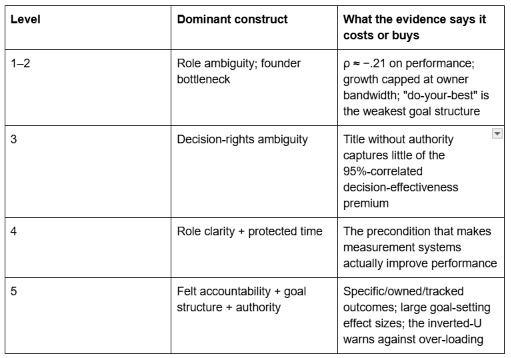
Role ambiguity depresses performance. The cleanest evidence comes from meta-analysis. Tubré and Collins (2000), pooling a large body of primary studies, estimate a negative population correlation of roughly ρ = −.21 between role ambiguity and job performance, modest in size but consistent across job types, and one of the more durable findings in organizational behavior. The mechanism is unsurprising: when it is unclear who does what, effort is misdirected, work is duplicated or dropped, and no one is positioned to learn from the result. Notably, the same meta-analysis finds role conflict (competing clear demands) far less damaging to performance (ρ ≈ −.07) than ambiguity (not knowing the demand at all). The expensive problem is not disagreement about the goal; it is the absence of a named owner of the goal.
Founder bandwidth becomes the growth ceiling. A second literature, more practitioner than peer-reviewed but strikingly consistent, describes the “founder’s trap.” McKinsey’s scale-up research frames it as a natural ceiling: the approach that builds a company to its first stage of scale stops working, and “what got them here will not get them there” (McKinsey, 2025). The structural insight that recurs across this work is that hiring adds capacity, but only the transfer of decisions and knowledge transfers capability. A founder who hires help yet retains every decision has relocated the bottleneck, not removed it. The owner’s role must shift from chief doer to chief decision-maker, which is exactly the transition the Level 1→4 movement describes.
“Do your best” does not work. Beneath both failure modes sits one of the most replicated findings in applied psychology. Across more than four hundred studies and roughly forty thousand participants, specific and difficult goals produce reliably higher performance than vague “do your best” exhortations, with meta-analytic effect sizes commonly in the d = .42 to .82 range (Locke & Latham, 2002; Klein et al., 1999). Locke and Latham’s summary is blunt: when people are merely asked to do their best, they do not. A business where growth is “whatever the owner handles when it surfaces” is, definitionally, operating on a do-your-best goal, the weakest motivational structure the literature has identified.
Level 3 — “Named, but decision rights negotiated case-by-case”
This is the most deceptive level, because it looks solved. Someone has the title. The trap is that authority has not moved with the name.
The canonical evidence here is Bain’s decision-rights research. Across a global survey of nearly 800 companies, Bain found that decision effectiveness and financial results correlate at the 95% confidence level or higher across every country, industry, and company size studied, with top-quintile decision performers generating total-shareholder returns several points above the rest (Rogers & Blenko, 2006; Blenko, Mankins & Rogers, 2010). The diagnosis Bain reports from the field is precisely the Level 3 condition: a named function, but “nobody really knew who had the final say,” so decisions stalled in process and rework. Their RAPID framework (Recommend, Agree, Perform, Input, Decide) exists to fix one thing, to ensure a single accountable decider, distinct from those who merely advise.
The lesson for the growth question is sharp. Naming a marketing or sales leader without granting and bounding their decision rights captures almost none of the available benefit. The title is necessary and nowhere near sufficient. A scope that is re-litigated every time a real decision arrives reproduces the ambiguity of Levels 1–2 inside a more expensive org chart.
Level 4 — “Defined scope, documented role, weekly time committed”
This is where the constructs begin to compound favorably.
Role clarity is the lever that converts measurement systems into performance. A useful strand of management-accounting research finds that comprehensive performance-measurement systems improve managerial performance indirectly. Their effect runs through role clarity and psychological empowerment, not around them (Hall, 2008). In plain terms: dashboards and reviews do little for a leader who does not have a clear, bounded role; they do a great deal for one who does. Level 4’s “documented role and committed time” is the precondition that makes everything downstream, KPIs, reviews, and forecasts actually move behavior.
Protected time is not a nicety; it is the unit of capacity. The practitioner literature on founder bandwidth converges on the same prescription the anchor encodes: immovable, protected blocks for the strategic work only the named leader can do. Without protected time, a “named leader” reverts under pressure to whoever has slack, usually the owner, and the organization silently slides back to Level 2.
Level 5 — “Written scorecard, defined authority, named outcomes”
The top anchor is the institutionalization of three evidence-backed mechanisms at once.
Felt accountability. When an individual perceives that their decisions will be evaluated by a legitimate audience with consequences attached, performance, citizenship behaviors, commitment, and trust all rise, the consolidated finding of the felt-accountability literature (Hall, Frink & Buckley, 2017). A written scorecard with named outcomes the business can articulate is the cleanest available instrument for inducing felt accountability: it specifies the audience, the standard, and the stakes. One honest caveat the same literature insists on: the relationship is not infinitely linear. Ferris and colleagues (1995) document that too much accountability, like too little, degrades performance, an inverted-U. A scorecard that names three outcomes concentrates effort; one that names thirty manufactures anxiety and evasion. The design choice, few, named, and owned outcomes is doing real work.
Goal structure. Level 5 is goal-setting theory made operational. A written (specific), owned (committed), tracked (fed back) outcome satisfies all three conditions the theory requires, specificity, commitment, and feedback that distinguish goals that move performance from goals that decorate a wall (Locke & Latham, 2002).
Decision authority. And it closes the Level 3 gap by pairing the named outcome with the named authority to pursue it, the single change Bain’s data associates most strongly with decision effectiveness and, through it, financial performance.
A summary of the ladder:
4. It is not only the person; it is the system around the person
A finding that the named, accountable leader matters could be misread as “hire a CMO.” The evidence points to something larger: the leader is a node in a system, and the system’s connective tissue is as consequential as the node.
The most-studied piece of that tissue is sales–marketing alignment, whether the people who generate demand and the people who convert it share definitions, data, and goals. Here the practitioner data is abundant and the academic data thinner, so precision about provenance matters. The widely circulated figures, aligned organizations growing materially faster while misaligned ones decline, originate largely with research and advisory firms (SiriusDecisions/Forrester, Aberdeen Group, LinkedIn, HubSpot) and are vendor-reported, not peer-reviewed: representative claims include roughly 24% faster three-year revenue growth for tightly aligned B2B organizations (SiriusDecisions) and a 32%-growth-versus-7%-decline spread (Aberdeen). These should be read as directional and self-interested, not as established effect sizes. The more credible signal is their consistency across independent commercial datasets, and the existence of at least some scholarly survey work (e.g., Peterson, Gordon & Palghat’s multi-dimensional study of ~800 respondents) pointing in the same direction.
The structural reading is the durable one: a single named owner of growth is valuable in part because ownership is what makes alignment enforceable. When marketing and sales report into one accountable leader with one scorecard, the alignment problem becomes an internal management problem rather than a perpetual interdepartmental negotiation. The person and the system are not alternatives; the named person is the mechanism by which the system gets a referee.
5. The AI turn and the central argument
Now the institute’s framing question. Generative and agentic AI are absorbing exactly the activities that used to define “doing marketing and sales”: drafting, testing, segmenting, optimizing, personalizing. McKinsey sizes the prize at $2.6–4.4 trillion in annual value across the economy, with marketing/sales among the four functions expected to capture the majority of it, and estimates that agentic systems could come to power as much as two-thirds of current marketing activities (McKinsey, 2023; 2026). If AI can execute the growth function, does the named human owner of growth become less necessary?
The evidence points emphatically the other way, for three reasons.
First — AI collapses the execution layer but raises the accountability layer. The thing AI is least able to supply is the thing Level 5 measures: a legitimate party who is answerable for the outcome. McKinsey’s own marketing-AI guidance states the requirement directly. The first steps in deploying generative AI are to establish an accountable leader and an oversight structure, with human review for anything customer-facing (McKinsey, 2023). When an agent can generate a thousand message variants overnight, the binding constraint is no longer who can make the content but who owns what the content does to the brand, the customer, and the number. That is an accountability question, and accountability cannot be delegated to a system that cannot be held responsible. The named owner does not get automated away; the named owner is what makes automation safe to scale.
Second — the returns to AI concentrate in organizations that already have clear roles and governance. This is the most important empirical finding for the institute’s thesis. In McKinsey’s 2025 State of AI survey, roughly 88% of organizations use AI but only about 6% qualify as high performers capturing material (5%+) EBIT impact. What separates them is not access to better models, those are commodities, but organizational redesign and governance: high performers are far more likely to fundamentally rework workflows and to run human-in-the-loop rules, centralized oversight, and explicit executive accountability for AI (McKinsey, 2025). Read against this brief’s ladder, the implication is direct: AI is a multiplier on a Level 4–5 growth structure and a risk amplifier on a Level 1–3 one. Drop powerful automation into an organization where “the owner handles whatever surfaces” and you do not get leverage; you get faster, cheaper, more confident error, with no one positioned to catch it. Roughly half of organizations already report at least one negative AI consequence, disproportionately, the ones without the governance scaffolding.
Third — role clarity is now a design principle for the machines too. A telling cross-over: the emerging research on multi-agent AI systems has begun importing “role clarity” directly from organizational behavior, citing the same Tubré-and-Collins line of work. because agents that lack clearly bounded roles drift, collide, and fail at collaborative tasks (see, e.g., recent multi-agent role-clarity work, 2026). The principle that a named, scoped, accountable role outperforms an ambiguous one is proving to be substrate-independent. It holds for humans, and it is being rediscovered as necessary for teams of humans and agents.
The synthesis. AI does not answer the question “who owns growth.” It raises the stakes of the answer. It cheapens execution toward zero and, in doing so, relocates the entire value of the growth function into the layers AI cannot occupy: judgment, authority, and answerability for named outcomes. Those are precisely Levels 4 and 5. The age of AI is not the era of the dispensable growth leader. It is the era in which the unclear growth leader becomes a liability the business can no longer afford, because the cost of ungoverned automated action compounds faster than the cost of ungoverned human action ever did.
6. What this evidence does not establish
Intellectual honesty requires the boundaries.
- Correlation, not proven causation. The Bain decision-effectiveness and the alignment findings are correlational. Better-run companies may both clarify roles and grow faster for a common third reason (e.g., stronger leadership). The maturity ladder is a credible hypothesis about direction, not a demonstrated causal lever.
- Vendor-reported alignment statistics are self-interested. Their consistency is suggestive; their specific magnitudes should not be cited as settled science.
- The maturity scale itself is, at present, face-valid. Like most instruments of its class, the OQ Score has not yet published reliability or predictive-validity statistics for this item; this brief evaluates the constructs the item measures, which are well-validated, not the item’s own predictive performance, which is not yet established.
- Effect sizes are moderate. The role-ambiguity correlation (≈ −.21) is real and replicated but not large; it is a contributing constraint, not a master variable. The honest claim is that role clarity is one of several reliable, low-cost levers, not a silver bullet.
7. Implications for the classroom and the research agenda
For MBA programs adopting this work, three teaching propositions are defensible from the evidence:
- Teach “who owns growth” as a measurable design variable, not a hiring decision. The lever is the structure, named role, bounded decision rights, written and owned outcomes, not the seniority of the title.
- Teach AI literacy as governance literacy. The differentiating skill in the AI era is not prompt-writing; it is the ability to construct accountability around automated systems. The growth leader of 2030 is measured less by what they produce and more by what they are answerable for.
- Teach the founder transition explicitly. The chief-doer-to-chief-decision-maker shift is the single most common growth ceiling in owner-operated firms, and it is teachable as a structural move (transfer decisions, not just tasks).
A research agenda follows naturally, and it is the unglamorous work that converts a plausible ladder into a validated one: publish inter-rater reliability for multi-respondent administrations; link maturity levels to realized growth outcomes over time; and isolate, ideally quasi-experimentally, whether organizations that move from Level 3 to Level 5 subsequently grow faster than matched peers that do not. Until that work exists, the responsible claim is the one this brief makes: the constructs are validated, the ladder is coherent, and the direction is clear, but the specific predictive power of the instrument is earned through data, not asserted.
For all evidence based research and academic papers, visit this link for updates. https://boisusa.com/category/inside-the-oq-score/
References
Blenko, M. W., Mankins, M. C., & Rogers, P. (2010). Decide & Deliver: Five Steps to Breakthrough Performance in Your Organization. Harvard Business Review Press.
Ferris, G. R., Mitchell, T. R., Canavan, P. J., Frink, D. D., & Hopper, H. (1995). Accountability in human resource systems. In Handbook of Human Resource Management.
Hall, A. T. (2008). Comprehensive performance measurement systems, role clarity, psychological empowerment, and managerial performance. (Management-accounting research stream; see also Hall, Frink & Buckley, 2017.)
Hall, A. T., Frink, D. D., & Buckley, M. R. (2017). An accountability account: A review and synthesis of the theoretical and empirical research on felt accountability. Journal of Organizational Behavior, 38(2), 204–224.
Klein, H. J., Wesson, M. J., Hollenbeck, J. R., & Alge, B. J. (1999). Goal commitment and the goal-setting process: A meta-analytic review. Psychological Bulletin, 125(1).
Locke, E. A., & Latham, G. P. (1990). A Theory of Goal Setting and Task Performance. Prentice-Hall.
Locke, E. A., & Latham, G. P. (2002). Building a practically useful theory of goal setting and task motivation. American Psychologist, 57(9), 705–717.
McKinsey & Company (2023). The economic potential of generative AI: The next productivity frontier; and The power of generative AI for marketing.
McKinsey & Company (2025). The state of AI in 2025: Agents, innovation, and transformation; and AI in the workplace: A report for 2025.
McKinsey & Company (2026). Reinventing marketing workflows with agentic AI.
Podsakoff, P. M., MacKenzie, S. B., Lee, J.-Y., & Podsakoff, N. P. (2003). Common method biases in behavioral research. Journal of Applied Psychology, 88(5), 879–903.
Rogers, P., & Blenko, M. (2006). Who has the D? How clear decision roles enhance organizational performance. Harvard Business Review, 84(1), 53–61. (See also Bain & Company, Score your organization to improve decision effectiveness.)
Tubré, T. C., & Collins, J. M. (2000). Jackson and Schuler (1985) revisited: A meta-analysis of the relationships between role ambiguity, role conflict, and job performance. Journal of Management, 26(1), 155–169.
Sales–marketing alignment benchmarks (vendor-reported, cited as such): SiriusDecisions/Forrester; Aberdeen Group; LinkedIn; HubSpot — as synthesized in industry reviews, 2023–2026. Scholarly survey work: Peterson, Gordon & Palghat (sales–marketing alignment, multi-dimensional study).
Over50Pros · Strategic Operations Advisory · Delivering a Growth path Without a High-Priced Consultant · Working paper, June 2026