
Process Codification, Organizational Memory, and the Repeatability of Customer Acquisition and Retention and What Artificial Intelligence Does to the Answer
A research brief prepared for institute fellows and MBA faculty
Over50Pros · Strategic Operations Advisory Working paper · June 2026 · Companion to “Who Owns Growth”
Framing note. This is a research brief, not a sales document. It is the second in a series addressing growth in companies. The first asked who owns growth; this one asks where growth lives and whether the knowledge of how a firm finds and keeps customers exists as a documented model, a scattered residue, a dead document, or a maintained, self-correcting playbook. The instrument under discussion — the Growth Work · Process item of the OQ Score — is used as a structured object of study. Where evidence is vendor-reported rather than peer-reviewed, it is flagged as such.
1. The question, stated precisely
The item reads: “When we describe how we find a new customer and keep an existing one, it lives…” with five behaviorally anchored states:
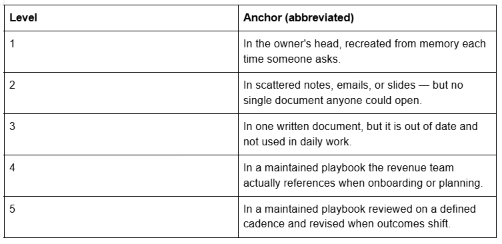
As with the Team item, these are not five amounts of one thing. They are four distinct constructs the literature treats separately: organizational memory (does the knowledge survive outside one head?), knowledge codification (has tacit know-how been externalized into explicit, transferable form?), process standardization-in-use (is the explicit form actually referenced in the work?), and closed-loop revision (does the document learn?). The instrument compresses them into one ladder. This brief un-compresses them, asks what the evidence says about each, and then asks the institute’s question: in a market increasingly run by digital and AI systems, does a written, maintained process matter more, or less?
The answer, defended below, is more and for a reason most owners have not yet internalized: a documented process is no longer merely good hygiene. It is the substrate on which automation runs. The thing that lives only in the owner’s head is now not just fragile; it is invisible to the machines that are absorbing the work.
2. Why “where growth lives” is genuinely hard to measure
Three problems discipline the claims that follow.
Tacit knowledge resists codification. The foundational distinction, from Polanyi (1966), is that we know more than we can tell. Nonaka and Takeuchi’s (1995) SECI model formalizes the organizational consequence: moving knowledge from tacit (in someone’s hands and habits) to explicit (in a document anyone can open) requires a deliberate, effortful conversion they call externalization, and it is, in their account, the hardest and most valuable of the four conversions. The Level 1→3 movement is externalization. It does not happen by accident, which is precisely why so many firms never leave Level 1.
Existence is not the same as use. A written process that no one references is not a process; it is an artifact. The instrument’s Level 3 (“a document, but stale and unused”) versus Level 4 (“a playbook the team actually references”) encodes a distinction the knowledge-management literature insists on and that naive measurement misses: codified-but-dormant knowledge produces almost none of the benefit of codified-and-circulating knowledge (Nonaka & Takeuchi, 1995, on combination and internalization). Counting documents overstates maturity. The question is whether knowledge moves.
Self-report and the residue problem. The owner reporting “it’s all written down” is rarely the person who tests whether a new hire can actually run the motion from the document. And some genuine residue, judgment, feel, and relationship history may never fully codify (Polanyi, 1966). The honest claim is not that everything can be written down, but that the firms which write down what can be written down systematically outperform those that leave it in one head.
3. The evidence, level by level
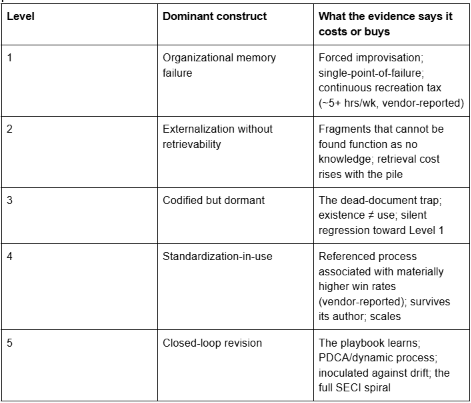
Level 1 — “In the owner’s head, recreated from memory”
This is the organizational-memory failure state, and it carries two distinct, documented costs.
Low organizational memory forces improvisation. Moorman and Miner (1998), in the Academy of Management Review, establish the relationship directly: when organizational memory is thin, firms improvise. They reconstruct solutions in real time rather than retrieving them. Improvisation has occasional upside, but as a default mode for customer acquisition and retention it guarantees inconsistency, non-transferability, and an inability to learn, because nothing is ever recorded to learn from. “Recreated from memory each time someone asks” is improvisation institutionalized.
The knowledge is a single point of failure. A growing empirical literature on knowledge loss through turnover (KLT) documents what departing key people take with them, sometimes labeled, vividly, “corporate amnesia” or “organizational Alzheimer’s” (Massingham, 2018; Girard, 2005). The practitioner data quantifies the everyday tax even before anyone leaves: knowledge workers reportedly spend on the order of five-plus hours per week waiting for information held by colleagues or recreating undocumented institutional knowledge (Panopto workplace study; vendor-reported). A business whose acquisition-and-retention method lives in the owner’s head is one resignation, one illness, or one scaling step away from losing the method entirely and is paying a recreation tax continuously in the meantime.
Level 2 — “Scattered notes, emails, slides — no single openable source”
This is partial externalization that fails on retrievability. The knowledge has begun to leave the owner’s head but has not been assembled into anything a second person can open and execute. In SECI terms the firm has attempted externalization without combination the consolidation of explicit fragments into coherent, usable knowledge. The literature on organizational memory loss identifies fragmented, hard-to-navigate knowledge stores as a primary cause of memory loss in their own right: knowledge that cannot be found is functionally knowledge that does not exist. Level 2 feels like progress over Level 1 and often is not, because the marginal fragment added to an unindexed pile raises the cost of retrieval as fast as it raises the stock of knowledge.
Level 3 — “One document, but stale and unused”
The dead-playbook trap. This is the level that most flatters a self-assessment and most deceives it. A document exists; the box is checked; the knowledge is, on paper, codified. But because it is neither maintained nor referenced, it delivers little. The knowledge-management literature is explicit that codified knowledge produces value only when it re-enters practice; Nonaka and Takeuchi’s internalization, explicit knowledge converting back into the tacit fluency of the people doing the work. A document that no one opens never internalizes. It is the “SOP as wallpaper” that practitioners describe: written once, never revised, and quietly diverged from until the real process again lives only in people’s heads, a silent regression to Level 1 wearing the costume of Level 3.
Level 4 — “A maintained playbook the revenue team actually references”
Here codification becomes operational, and the performance evidence, while largely vendor-reported and to be read as such, is consistent in direction and unusual in its agreement.
The most relevant body is the CSO Insights / Miller Heiman sales-research program, which has surveyed on the order of a thousand-plus companies annually for two decades. Its central construct, the Sales Relationship/Process Matrix, ranks firms from random to dynamic process. The reported gradient is steep: in one widely cited year, firms at the lowest process level posted roughly a 39% win rate versus about 51% for firms with the most developed process (Miller Heiman Group, 2015). Subsequent work on sales-enablement formality reported that moving from random/informal to formal, dynamic approaches was associated with win rates roughly 17.9% higher and quota attainment roughly 11.8% higher than study averages (CSO Insights, as reported 2019). These figures originate with a sales-methodology vendor and should be treated as directional, not as established effect sizes, but the shape of the finding (referenced, structured process beats improvised process) is corroborated across independent commercial datasets and is what the construct predicts.
The structural reading: a playbook the team references when onboarding or planning is what makes a method survive its author and scale to a second practitioner. It is also the precondition for the retention half of the mandate, to which we return in Section 4.
Level 5 — “Reviewed on a defined cadence and revised when outcomes shift”
The top anchor is the closed loop, and it is the most theoretically grounded of the five. It operationalizes the plan-do-check-act cycle (Deming/Shewhart) and the learning-organization thesis: a process that is reviewed against outcomes and revised when they shift is a process that learns. The same CSO Insights matrix names its top tier “dynamic” precisely because the highest-performing firms treat process as a living instrument, not a fixed document.
Two things make Level 5 categorically different from Level 4. First, it converts the playbook from a memory device into a learning device, the difference between recording what worked and systematically discovering what works better. Second, it inoculates against the silent regression that kills Level 3 documents: a scheduled review cadence is the mechanism that keeps the explicit and the actual from drifting apart. In SECI terms, Level 5 is the full spiral, tacit insight from the field externalized, combined into the playbook, internalized by the team, generating new tacit insight, on a cadence.
A summary of the ladder:
4. Acquisition and retention — the half that is almost never written down
The instrument item deliberately pairs two motions: find a new customer and keep an existing one. This matters, because the economics of the second are larger and its documentation is rarer.
The foundational evidence is Reichheld’s work at Bain. Across industries, a 5% increase in customer retention was associated with profit increases of roughly 25% to 95% (Reichheld & Sasser, 1990, HBR; Reichheld, 1996) in financial services specifically, a 5-point retention gain produced more than a 25% profit gain. The cost asymmetry is equally stark in the widely cited (and HBR-attributed) figures: acquiring a new customer runs roughly 5 to 25 times the cost of retaining one, and the probability of selling to an existing customer (≈60–70%) dwarfs that of a new prospect (≈5–20%) (Marketing Metrics, as commonly cited). These specific multipliers circulate widely and should be cited with care as to provenance, but the underlying loyalty-economics finding is among the better-established in the field.
Here is the structural point that connects retention back to the process ladder: the retention motion is the half of growth most likely to live entirely in Level 1. Firms routinely document some of acquisition via a pitch deck, a lead form, a CRM stage. They almost never document retention: the renewal conversation, the early-warning signals of churn, the onboarding sequence, the save play. Retention, being relational and tacit, resists externalization most and is therefore lost to turnover most. Yet it is where the profit is. A maintained playbook is the only structure that makes the highest-ROI motion in the business repeatable rather than heroic, and that converts proactive retention (which Forrester-type research associates with meaningful churn reduction) from an individual’s instinct into an institutional capability.
The first two briefs converge here: the named owner (Brief 1) is who makes the playbook enforceable; the maintained, reviewed playbook (Brief 2) is what makes the owner’s method survivable and scalable. Person and process are not alternatives. Each is the other’s insurance.
5. The AI turn and the central argument
Now the institute’s framing question. Agentic AI is moving from drafting and analysis toward executing customer-facing workflows, qualifying leads, sequencing outreach, onboarding accounts, and handling renewals. If software can run the motion, does a written process matter less? The evidence points hard the other way, for three reasons.
First, undocumented processes are invisible to AI in a way it never was to humans. A human employee dropped into a Level 1 firm can shadow the owner, absorb the tacit method, and improvise around the gaps. An AI agent cannot. As enterprise-AI practitioners put it bluntly, an agent cannot fall back on tribal knowledge and cannot pattern-match its way past a vague definition (Starburst, 2026). The dominant grounding technique, retrieval-augmented generation, works by injecting an organization’s explicit documents (SOPs, playbooks, policies) into the model’s context; with no documents, there is nothing to retrieve and nothing to ground on, and the system either refuses or hallucinates. Level 1, which merely handicaps a human organization, fully excludes an AI one. The knowledge in the owner’s head is, to the agent, knowledge that does not exist.
Second — AI ROI concentrates on already-documented, already-measured processes. The consistent practitioner finding in 2026 is that optimal agent ROI emerges from layering agents onto already efficient, well-documented processes backed by robust SOPs and clear performance and error metrics, and that an agent applied to a poorly run, undocumented process simply does the bad process faster (industry analyses, 2026). The recommended deployment pattern is itself a governance ladder. Suggest-only, then execute-with-approval, then autonomy that presupposes a documented baseline against which to judge the agent’s output. The useful analogy that recurs in the literature: a modern AI agent behaves like a new hire given unrestricted access to your systems. No competent firm onboards such a hire without a playbook. Mapped onto this brief’s ladder, the implication is exact: AI is a multiplier on a Level 4–5 process and a hazard on a Level 1–3 one.
Third — AI changes the cost-benefit of maintenance, the very thing that historically killed playbooks. The reason most firms stall at Level 3 is that maintaining a living playbook is laborious; documents rot because keeping them current costs more attention than teams will spend. AI inverts this. The same systems that require documented processes are increasingly able to help produce and maintain it, drafting SOPs from recorded calls and tickets, flagging where the explicit process and the observed process have diverged, and refreshing context continuously rather than on a heroic quarterly push. Emerging research on capturing and embedding codified human expert knowledge into agents (e.g., SOP-aware retrieval and expert-rule frameworks, 2026) is, in effect, Nonaka’s externalization performed at machine speed. AI thus does two things at once: it raises the value of a maintained playbook (because automation depends on it) and lowers the cost of maintaining one (because automation can help keep it alive). That combination is what makes Level 5, historically aspirational for owner-operated firms, newly attainable.
The synthesis. AI does not retire the playbook; it promotes it from documentation to infrastructure. In a pre-AI world, “it lives in the owner’s head” was a fragility. In an AI world it is a disqualification, from automation, from safe scaling, from the productivity frontier that is concentrating in firms whose processes are explicit, measured, and governed. The market is not making written processes optional. It is making the unwritten process unrunnable by the systems that will run everything else.
6. What this evidence does not establish
- The sales-process performance figures are largely vendor-reported. Their consistency across independent datasets is suggestive; their precise magnitudes (win-rate and quota deltas, the “28% higher win rate” figure that circulates secondhand) should not be cited as settled science.
- Correlation, not proven causation. Firms with mature processes may also possess stronger management, capital, or markets. The ladder is a credible directional hypothesis, not a demonstrated causal lever, and the maturity instrument itself has not yet published predictive-validity statistics for this item.
- Some knowledge will not codify. Polanyi’s caution holds: relationship feel and situated judgment have a residue that resists full externalization. The defensible claim is that firms which codify the codifiable outperform those that leave it in one head, not that everything reduces to a document.
- Retention multipliers are heuristics, not laws. The 5%→25–95% and 5–25× figures are robust as direction and order of magnitude; their exact values are industry-dependent and frequently recirculated without their original conditions.
7. Implications for the classroom and the research agenda
Three teaching propositions are defensible from the evidence:
- Teach process codification as a measurable maturity variable, not a documentation chore. The lever is the movement of knowledge, externalized, referenced, and revised on a cadence, not the existence of a file. Existence-versus-use is the distinction students most often miss.
- Teach retention documentation as the neglected, high-ROI frontier. The motion with the largest profit leverage is the one most likely to live only in someone’s head. Make students document a retention playbook, not just an acquisition funnel.
- Teach AI readiness as process readiness. The differentiating organizational skill in the AI era is not model selection; it is the discipline of maintaining explicit, measured, governed processes, the substrate without which agents cannot be deployed safely or productively.
The research agenda follows: link process-maturity levels to realized acquisition and retention outcomes longitudinally; test whether referenced playbooks (Level 4) outperform existing-but-dormant ones (Level 3) at equal documentation volume, isolating use from existence; and study, as AI tooling matures, whether it measurably lowers the maintenance cost that has historically trapped firms at Level 3, the empirical question on which this brief’s central AI claim ultimately rests.
For all evidence based research and academic papers, visit this link for updates. https://boisusa.com/category/inside-the-oq-score/
References
Deming, W. E. (1986). Out of the Crisis. MIT Press. (Plan-Do-Check-Act / Shewhart cycle.)
→ https://mitpress.mit.edu/9780262541152/out-of-the-crisis/
Girard, J. P. (2005). Taming enterprise dementia in public sector organizations. International Journal of Public Sector Management. (Corporate amnesia / “enterprise dementia”; as reviewed in the knowledge-loss-through-turnover literature.)
→ https://scholar.google.com/scholar?q=Girard+2005+taming+enterprise+dementia+public+sector
Massingham, P. (2018). Measuring the impact of knowledge loss: a longitudinal study. Journal of Knowledge Management, 22(4), 721–758. (Knowledge loss through turnover; “corporate amnesia.”)
→ https://doi.org/10.1108/JKM-08-2016-0338
Miller Heiman Group / CSO Insights (2015; 2019). Sales Performance Optimization Study and Sales Enablement Study. (Sales Relationship/Process Matrix; vendor-reported win-rate and quota figures.)
→ 2019 Sales Enablement Study (full PDF): https://salesenablement.pro/assets/2019/10/CSO-Insights-5th-Annual-Sales-Enablement-Study.pdf
→ 2018–2019 Sales Performance Study (SRP Matrix; press release w/ download link): https://www.prweb.com/releases/CSO_Insights_by_Miller_Heiman_Group_Releases_2018_2019_Sales_Performance_Study_Selling_in_the_Age_of_Ceaseless_Change_/prweb16059396.htm
(Note: csoinsights.com is defunct; research now under Korn Ferry. The 2015 SPO Study is no longer hosted at a stable public URL.)
Moorman, C., & Miner, A. S. (1998). Organizational improvisation and organizational memory. Academy of Management Review, 23(4), 698–723.
→ https://doi.org/10.5465/amr.1998.1255634
→ Free author PDF (Duke): https://people.duke.edu/~moorman/Publications/AMR1998.pdf
Nonaka, I., & Takeuchi, H. (1995). The Knowledge-Creating Company. Oxford University Press. (SECI model; tacit/explicit conversion; externalization.)
→ https://global.oup.com/academic/product/the-knowledge-creating-company-9780195092691
Polanyi, M. (1966). The Tacit Dimension. University of Chicago Press.
→ https://press.uchicago.edu/ucp/books/book/chicago/T/bo6035368.html
Reichheld, F. F., & Sasser, W. E. (1990). Zero defections: Quality comes to services. Harvard Business Review, 68(5), 105–111.
→ https://hbr.org/1990/09/zero-defections-quality-comes-to-services
See also Reichheld, F. F. (1996), The Loyalty Effect, Harvard Business School Press.
→ https://www.google.com/books/edition/_/HFNcAAAAMAAJ
Retention multipliers (5–25× acquisition cost; 60–70% vs 5–20% sell-through): Cited as heuristics with provenance noted.
→ Acquisition vs. retention cost (HBR, Gallo 2014): https://hbr.org/2014/10/the-value-of-keeping-the-right-customers
→ 60–70% vs 5–20% sell-through (Farris, Bendle, Pfeifer & Reibstein, Marketing Metrics): https://books.google.com/books/about/Marketing_Metrics.html?id=7Ptw4nBoGmkC
Enterprise AI grounding and agent-readiness (2026): practitioner analyses on RAG/SOP grounding; academic work on codifying expert domain knowledge into LLM agents; organizational-memory recreation-tax figures.
→ Starburst (RAG / enterprise grounding resources): https://www.starburst.io/blog/
→ SOP-aware retrieval / expert-rule LLM-agent frameworks (no single canonical paper — arXiv listing): https://arxiv.org/list/cs.AI/recent
→ Recreation-tax figures (Panopto Workplace Knowledge & Productivity Report): https://www.panopto.com/blog/how-much-time-is-lost-to-knowledge-sharing-inefficiencies-at-work/
Over50Pros · Strategic Operations Advisory · Delivering a Growth path Without a High-Priced Consultant · Working paper, June 2026